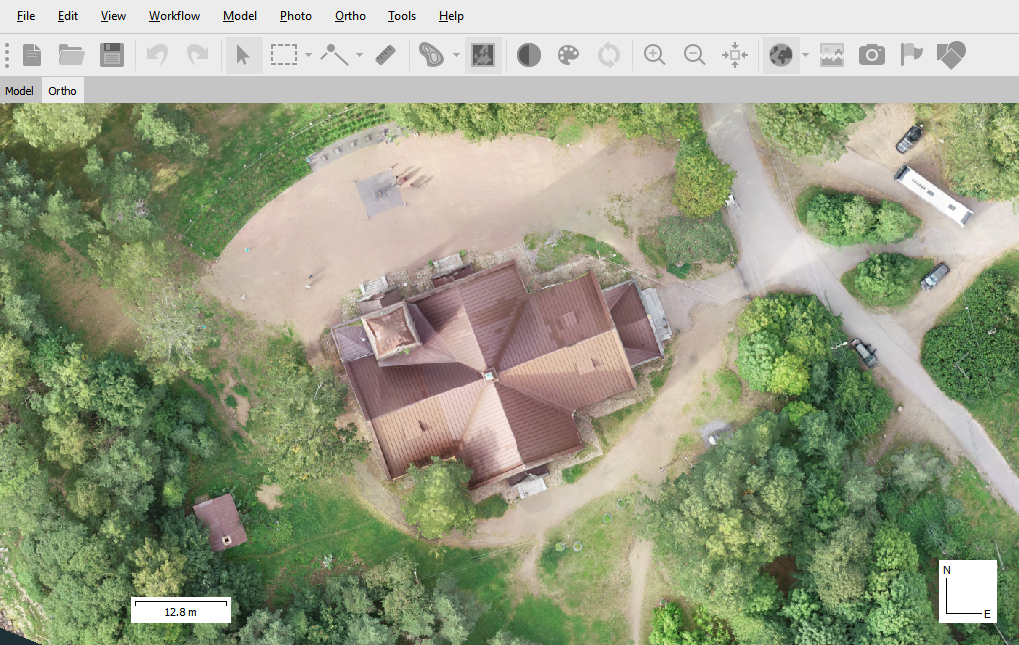
In this article, we describe how to process DJI drone images with RTK data in Agisoft Metashape Professional. Using RTK coordinates of camera locations provides more accurate results, even when no GCPs are utilized. The main steps and our recommendations can be found in the description of each step below:
To evaluate the accuracy, we recommend using ground control points. During the measurement of image coordinates, various problems may occur, and the coordinates may be inaccurate. To evaluate the measured coordinates, it is better to use check points.
Add Photos
To add photos, select Add Photos... command from the Workflow menu (Workflow > Add Photos...).
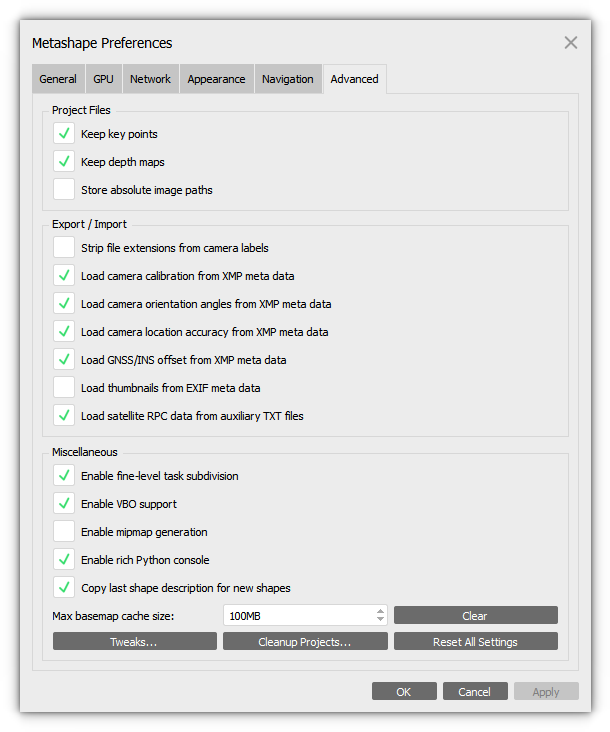
Enable "Load camera location accuracy from XMP meta data" option in the Advanced tab (Tools > Preferences > Advanced) prior to the image loading in order to read and apply the measurement accuracy of the camera locations data.
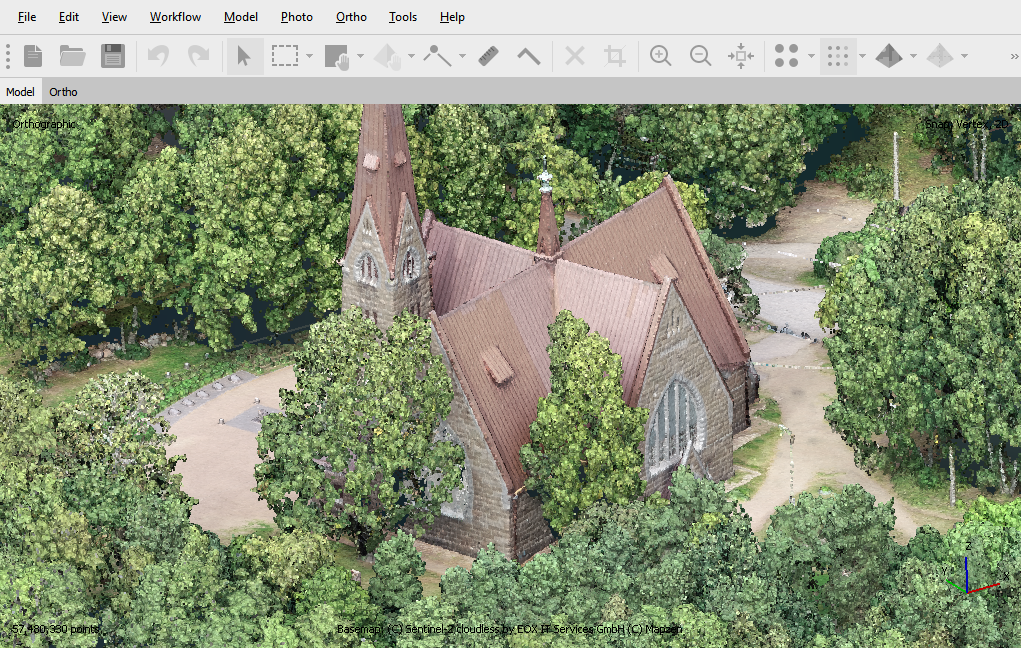
The camera position will be displayed in the Model view:

Accuracy values for all the respective cameras can see on the Reference pane. Otherwise default accuracy value (10 m) will be assumed for all camera coordinates in the chunk, hence, the value of the RTK/PPK measurements will efficiently be lost and the processing results will not be referenced with expected accuracy.

Align Photos
1. Select Align Photos... command from the Workflow menu (Workflow > Align Photos...).
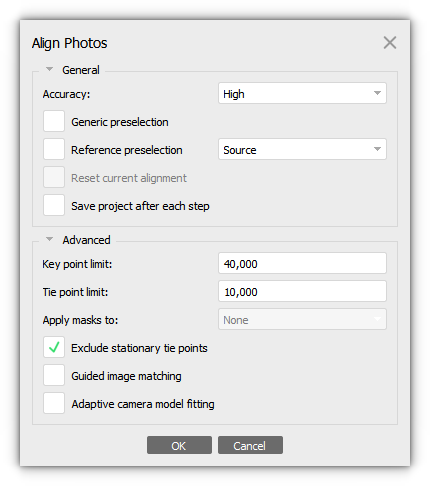
2. Set the parameters in the Align Photos dialog window:
3. Click OK button.
4. The progress dialog box will appear displaying the current processing status. To cancel the processing click Cancel button.
5. Alignment having been completed, computed camera positions, and a tie point cloud will be displayed.

When using GNSS during shooting, there may be a systematic shift between the coordinate system of the images and the coordinate system of the reference data (ground control points). The linear values of this shift can be calculated in Metashape. It is important that the project has GCPs and their positions are clarified on the photos. And it is also important to enable checkboxes for image coordinates on the Reference pane.
To minimize and calculate this error, enable the Adjust GNSS bias option on the GNSS Bias tab in the Camera Calibration dialog box (select Tools > Camera Calibration). Then, after alignment, the updated bias data will be available. If these offsets are known, it is also important to specify them. In this case enable checkbox for the Enable Reference option and specify the parameters: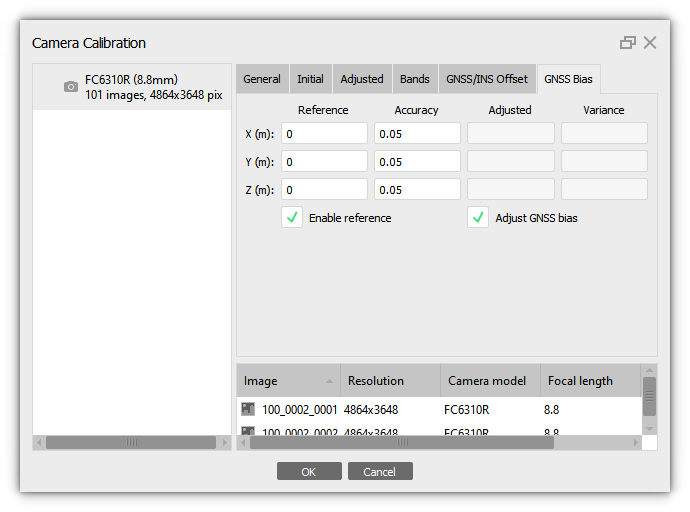
Optimization
1. Click the Optimize toolbar button on the Reference pane.
2. In the Optimize Camera Alignment dialog box, check additional camera parameters to be optimized.
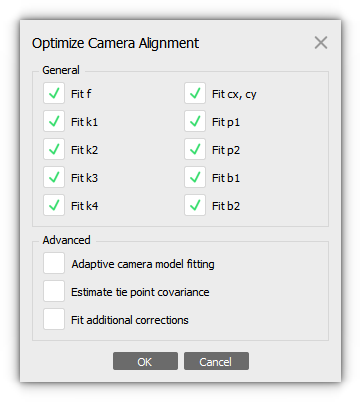
Usually, we recommend optimizing the camera alignment after placing the GCPs or in case RTK GPS data for cameras is used. In most cases, the complete set of the parameters (excluding b1 and b2 in project with GCPs and k4 for DJI M4E) is recommended for optimization.Sometimes for RTK drone data, it may be helpful to enable "Fit additional corrections" option to get more accurate alignment results.
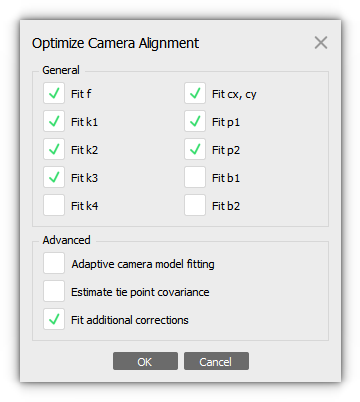
3. Click the OK button to start optimization.
Build Point Cloud
1. Select Build Point Cloud... command from the Workflow menu (Workflow > Build Point Cloud...).
2. In the Build Point Cloud dialog box select the desired reconstruction parameters and click the OK button.
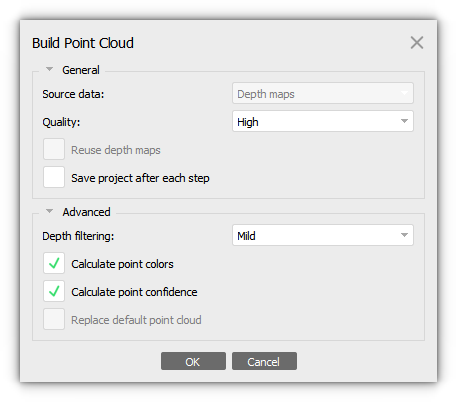
3. The progress dialog box will appear displaying the current processing status. To cancel the processing, click on the Cancel button.
Build DEM
1. Select the Build DEM... command from the Workflow menu (Workflow > Build DEM...).
2. In the Build DEM dialog box, set parameters.
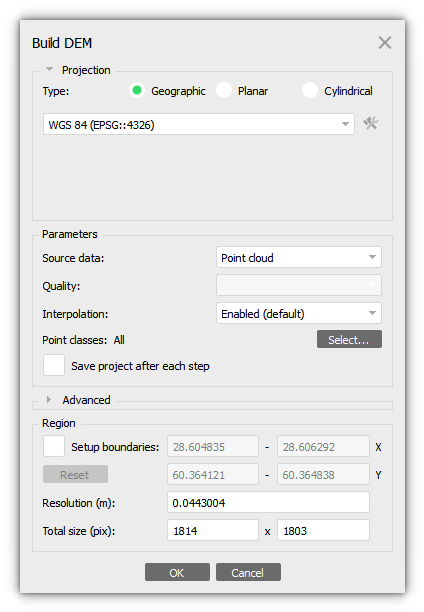
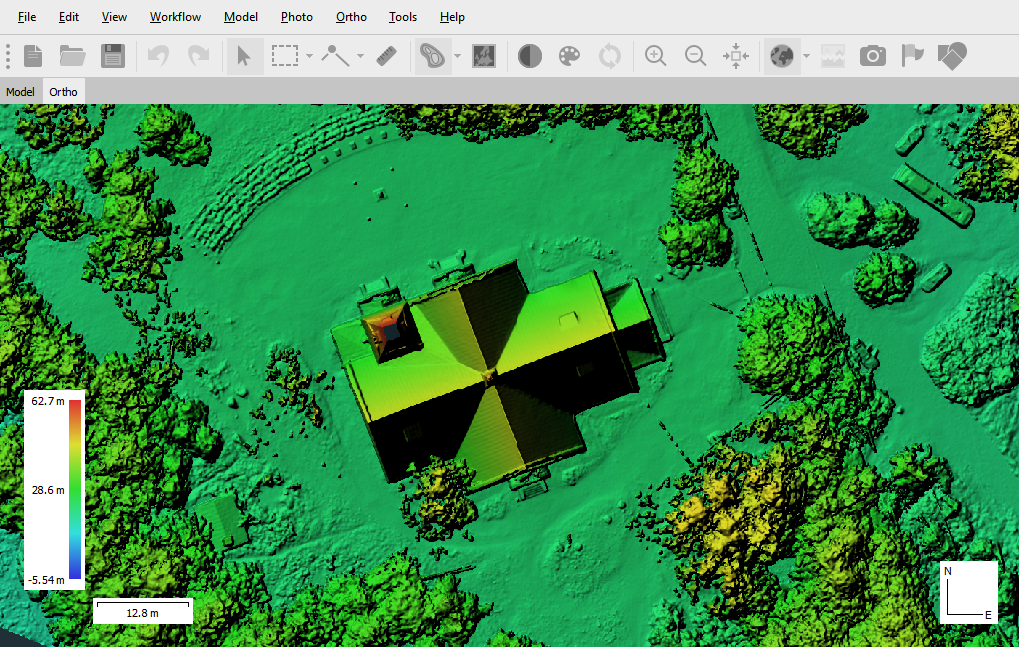
3. Click the OK button. The progress dialog box will appear displaying the current processing status. To cancel processing, click the Cancel button.
Build Orthomosaic
1. Select the Build Orthomosaic... command from the Workflow menu (Workflow > Build Orthomosaic...).
2. Set parameters in the Orthomosaic dialog window.
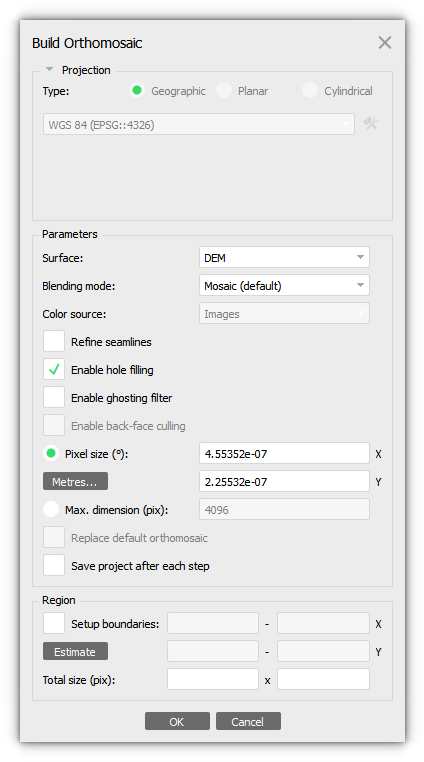
3. Click the OK button. The progress dialog box will appear displaying the current processing status. To cancel the processing, click the Cancel button.